
Structural Drying & Dehumidification — Northern Illinois
Water extraction removes what you can see. Structural drying removes what you can’t. Commercial dehumidifiers and air movers, sized correctly for the affected area, with daily moisture monitoring and complete drying logs for your insurance claim. Serving McHenry, Lake, Kane, DuPage, and northern Cook County since 1987.
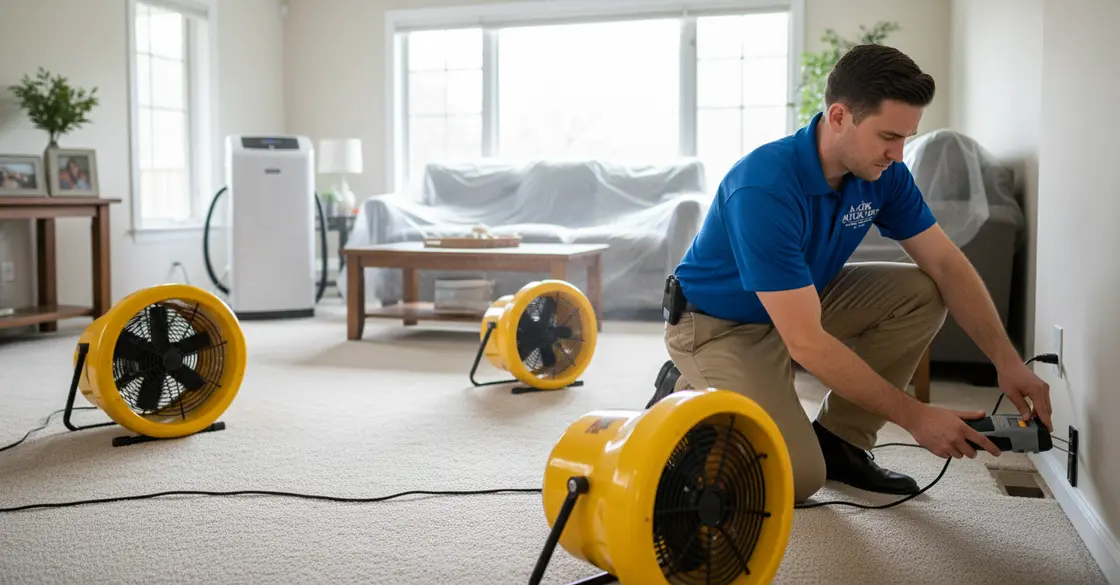
Commercial Drying Equipment We Use
Consumer-grade equipment from a hardware store is designed for everyday moisture maintenance. Our commercial equipment is sized and specified for water damage — a materially different challenge.
Commercial Dehumidifiers
Industrial low-grain refrigerant (LGR) dehumidifiers remove 150+ pints of moisture per day — compared to 30–50 pints for a consumer unit. Positioned strategically throughout affected areas, they pull moisture out of the air that evaporates from wet structural materials.
High-Velocity Air Movers
Air movers (axial fans) accelerate evaporation by moving high-velocity air across wet surfaces. The faster the air moves, the faster moisture leaves wet materials. Proper placement angles air beneath carpet, against drywall, and along baseboards where moisture pools.
Desiccant Dehumidifiers
For extreme moisture conditions or very cold spaces, desiccant dehumidifiers work differently than refrigerant units — they adsorb moisture chemically and work effectively even in near-freezing temperatures. Useful for crawl spaces and unheated garages in Illinois winters.
Moisture Meters & Thermo-Hygrometers
Penetrating and non-penetrating moisture meters let us read moisture content in drywall, wood, and subfloor without always needing to open walls. Thermo-hygrometers track ambient temperature and relative humidity — both affect drying rate and are logged daily.
Thermal Imaging Camera
Infrared cameras show temperature differentials that often indicate hidden moisture — wet insulation behind a wall, saturated subfloor under flooring. This lets us map the drying challenge accurately and place equipment where it matters.
Structural Drying — How It Works
Structural drying is a monitored process, not a “set it and forget it” job. Here is what happens from equipment setup to final clearance.
Baseline Moisture Assessment
Before equipment goes in, we take baseline readings on all affected surfaces and document them. Drywall, subfloor, framing, concrete — each material has a different target moisture range. The baseline tells us how far we are from dry and sets expectations for timeline.
Equipment Placement
Commercial dehumidifiers and air movers are placed based on the moisture map — not just pointed at the obvious wet spots. Placement considers airflow patterns, material types, and the volume of moisture that needs to be moved. We calculate equipment quantity based on the affected square footage and material types.
Daily Monitoring & Adjustment
We return daily to take moisture readings on all monitored points. As materials dry, equipment placement is adjusted — moving air movers to the next wet section, adding capacity if drying is slower than expected. Every reading is recorded in the drying log.
Insurance-Grade Drying Documentation
The drying log documents daily readings, equipment in place, ambient conditions, and the trajectory toward target moisture levels. Insurance adjusters expect this documentation. Without it, claims can be disputed. We've worked with every major carrier in northern Illinois.
Target Moisture Verification
We don't remove equipment because a surface looks or feels dry. We remove it when moisture readings on all monitored materials hit or come within range of target levels — which vary by material type and local equilibrium moisture content for the season.
Final Documentation & Walkthrough
Final readings are documented, compared to baseline, and compiled into the completed drying record. We walk through the results with you and explain what was done, what materials may have been affected, and any recommendations for repair or follow-up.
Why Not Just Fans and Open Windows?
We hear this often. Here are the honest answers.
Why not just use household fans and open windows?
Household fans move surface air but cannot control humidity. If outdoor humidity is high — common in Illinois summers — opening windows actually brings more moisture into the structure. Commercial dehumidifiers remove moisture from the air regardless of outdoor conditions. Fans alone can give wet materials the appearance of drying while moisture stays trapped inside walls and subfloor.
Why not just run the HVAC to dry things out?
Your HVAC system is designed to maintain comfortable temperatures, not to dry structural materials. Its dehumidification capacity is limited and it cannot target the concentrated moisture conditions in a water-damaged space. Running it aggressively can also circulate contaminated air throughout the house if the damaged area isn't properly isolated.
Why does proper drying matter for insurance?
Insurance adjusters increasingly require documented proof of professional drying — not just extraction. A drying log with daily moisture readings shows that the structure was genuinely dried and that future mold or structural damage isn't the result of improper remediation. Without documentation, claims for secondary damage can be denied.
Structural Drying — FAQ
How long does structural drying take?
For a standard residential water loss — a contained pipe burst or manageable flood — structural drying typically takes 3–5 days with commercial equipment running continuously. Larger events, materials with high moisture content, or colder temperatures can extend this to 5–7 days. We monitor daily and remove equipment when readings confirm completion — not on a preset schedule.
Is all that equipment necessary, or is it overkill?
The equipment quantity is calculated based on the affected area and material types — it's not arbitrary. Under-equipped drying takes longer, extends risk of mold, and can leave hidden moisture in walls or subfloor that causes long-term damage. Over-equipped drying completes faster and costs less in the end. We size the job appropriately and can explain the calculation.
Can I stay home while drying equipment runs?
Yes, in most cases. Commercial drying equipment is loud — similar to a window air conditioner running continuously. Dehumidifiers also generate heat, which can raise the temperature in the affected area. Most homeowners stay in unaffected parts of the house during the drying period. For very large losses or certain contamination situations, temporary relocation may be advisable.
What's the target moisture content for structural drying?
Target moisture content varies by material. For wood framing and subfloor, we're typically targeting 12–15% moisture content, close to local equilibrium moisture content (EMC). Drywall targets are lower. Concrete slabs have different measurement approaches. In northern Illinois, seasonal EMC shifts — drying to summer targets in winter is unnecessary and can cause problems when materials re-equilibrate. We use local EMC standards.
What happens if structural drying isn't done correctly?
The most common consequences of inadequate structural drying: mold growth in walls, ceilings, or under floors — sometimes months after the initial event; subfloor rot leading to soft spots in flooring; wood framing deterioration that creates structural issues; and difficulty with insurance claims for secondary damage. These problems are often more expensive to fix than the original water damage.